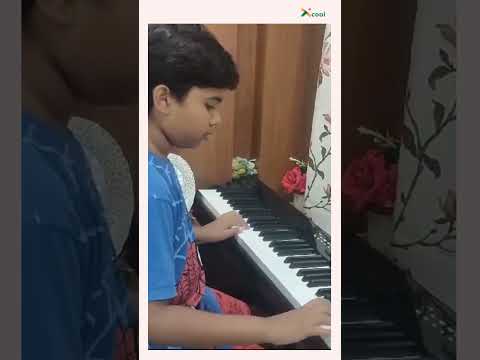
Keyboard for Trinity Initial Grade by Sumit Kukreja
- Introduction to white and black keys, octaves, and middle C.
- Identifying notes on the keyboard and their corresponding notation on the staff.
- Understanding the treble and bass clefs.
- Note values: whole, half, quarter, and eighth notes.
- Basic time signatures (2/4, 3/4, 4/4)
- Playing simple tunes using five-finger patterns.
- Familiarization with C major, G major, and F major positions
- Learning simple major chords (C, F, G, Am).
- Playing basic chord progressions to accompany right-hand melodies.
- Combining simple melodies with chord accompaniment.
- Coordinating both hands for rhythm and timing.
- Five-finger warm-up exercises.
- Hanon exercises for strength and agility.
- Simple scale practice (C major, G major).
- Clapping and recognizing simple rhythmic patterns.
- Identifying high and low pitch sounds.
- Basic dynamics: piano (p), forte (f), crescendo, and diminuendo.
- Simple articulation: legato and staccato.
- Practicing three pieces from the Trinity Initial Grade repertoire.
- Simple sight-reading exercises.
- Aural exercises to identify rhythms and pitch differences.
- Break melodies into small sections and practice hands separately before combining.
- Use slow, controlled movements to develop accuracy before increasing speed.
- Focus on smooth transitions between chords and maintaining a steady rhythm.
- Teacher-led evaluations through weekly progress checks.
- Mock performance to simulate the Trinity Initial Grade Exam environment.
- Ear training tests and sight-reading exercises.
This 12-hour beginner-friendly online course offers one class per week, taught by our most experienced and qualified teachers. Get personalized guidance and start your certification journey with assurance!
1. Understanding the Keyboard
2. Learning Music Notation
3. Right-Hand Melodies
4. Basic Chords (Left-Hand Accompaniment)
5. Hands Together Playing
6. Finger Exercises for Dexterity
7. Rhythm & Ear Training
8. Introduction to Musical Expression
9. Preparation for Trinity Initial Grade Exam
10. Practice Tips
11. Assessment Methods
- Students will confidently read and play simple melodies with the right hand and basic chords with the left hand.
- They will develop proper hand coordination, rhythm, and finger dexterity through structured exercises.
- They will understand basic music notation, time signatures, and dynamic markings.
- By the end of the course, students will be prepared to appear for the Trinity Initial Grade Exam with a strong foundation in keyboard playing.
Trinity College London
Course Highlights
Features
Expert-designed curriculum
Access to textbook, audio & video resources
Outcome oriented course design
₹ /session
Free demo
Get to know the Teacher
Discuss what you would like to learn
Free
See what they've learned